This Chuncheon Travel Guide helps you make the most of your day in the city. It features a well-thought-out itinerary and a detailed budget for the trip.
Disclaimer: Some information in this Chuncheon Guide changes too often. If you continue reading this article, you agree to cross-check information with concerned authorities. Read the full Terms.
Introduction
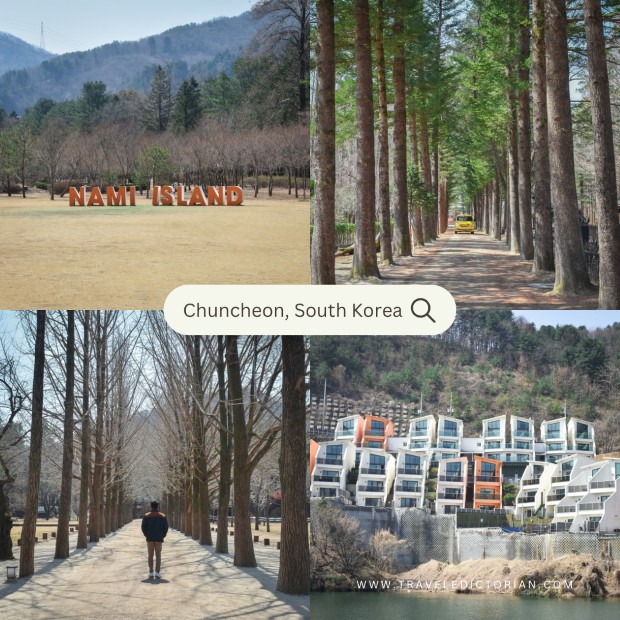
East of the Seoul Metropolitan Area sits the capital of Gangwon Province, Chuncheon. It is a densely forested city well-known for its charming piece of land, Nami Island, which consistently draws visitors due to its scenic landscape and romantic atmosphere.
On my fifth day in South Korea, I pay a brief visit to Chuncheon following a hectic four-day trip in Incheon and Seoul. To reach the city, it requires at least an hour via overland journey. So, I then catch an earlier schedule to see Nami Island during a less congested period. I boarded the Seoul Metro Line 1 to Cheongnyangni Station and then made a quick transfer for another train heading for Chuncheon.
Unfortunately, I embarked on the incorrect route that runs toward Gyeonggi Province. Since my phone isn’t internet ready, I began to feel dismayed and concerned. I took the chance to speak with an old man. Then, he instructed me through indistinct words and gestures to go back and get off at Sambong Station and catch the Chuncheon-bound Gyeongchun Line.
After facing a slight drawback on my way to Naminara Island, I continued and got a sight of the island’s scenic views. The tree-lined avenues and its sweeping open spaces are some of its features to look forward to when visiting Nami, making it a favorite retreat for those seeking quietude from the fast-paced urban living.
Disclosure: This post may contain affiliate links. Thus, I earn a small commission at no extra cost to you for the purchases made through these links.
Quick Fact About Chuncheon
Nami Island rose into prominence for being the filming location of the 2002 Korean hit drama series, “Winter Sonata.” Thus, a life-sized statue of the two lead characters was placed next to Metasequoia Lane.
Visa in South Korea
Bearers of foreign passports planning a trip to South Korea should contact the Embassy of the Republic of Korea in relation to entry requirements. Otherwise, consult iVisa.com, a reputable and trusted visa service provider.
When visiting South Korea for tourism, Philippine passport holders must apply for a tourist visa. That being said, learn about the Korean visa application and its essential requirements.
Standard Time in Chuncheon
The Coordinated Universal Time (UTC) in Chuncheon is UTC +09:00.
Chuncheon is thus an hour ahead of Manila, five hours ahead of Dubai, and seven hours ahead of Paris. The city is also eight hours ahead of London and thirteen hours further ahead of New York City. On the other hand, Chuncheon lags behind Sydney by an hour and shares the same time with Tokyo.
Climate in Chuncheon
Chuncheon and other parts of Korea share a humid continental climate with China and Japan. As such, the city experiences distinct weather variations with warm to sweltering summers and severely cold and icy winters.
Best Time to Visit Chuncheon
Chuncheon has four different seasons, as is typical of the temperate region. Because of this, it has distinct features that blend well with each varying season.
March to May
The spring season in Chuncheon runs from March through May. As such, the springtime delivers pleasant weather with a moderate temperature and slight humidity and brings a slight chance of rain.
During the spring season, Gongjicheon Park, a scenic riverbank route, is lined with cherry trees, making it a perfect avenue for “beot-kkot nori,” or cherry blossom viewing.
Chuncheon Travel Guide Tip: Witness the Chuncheon International Mime Festival, an annual event that showcases world class entertainment, which takes place from late May to early June.
June to August
In Chuncheon, the summer season begins in June and lasts until August. Due to its inland location, the city experiences a noticeably warmer temperature than the coastal cities, including Incheon and Busan.
In addition, the summertime brings frequent typhoons and downpours, especially in July, the wettest month, which may disrupt some outdoor activities.
September to November
Like spring, the autumn season is the finest time of the year to visit Chuncheon for its mild temperature and a little likelihood of rain, specifically in October. Gangwon has a thickly forested terrain where mountains are carpeted with trees.
As such, the province – including Nami Island – offers breathtaking vistas of blazing foliage that are perfect for sightseeing.
December to February
Chuncheon’s wintry season, which extends from December until February, is extremely cold and often snowy. January, the coldest month, is below freezing. As such, don extra layers of winter clothes to stay warm on the severely cold weather.
Seollal, also called Korean Lunar New Year, is the most widely anticipated public holiday in South Korea and typically falls in January or February. Tourists may likely to expect a three-day business closure.
Do you enjoy a surge of adrenaline? Put on your snowsuits and get ready, as a range of alpine sports awaits you at the Elysian Ski Resort. Get the Elysian Gangchon Ski Passnow!
Chuncheon Travel Guide Tip: South Korea is highly susceptible to “Yellow Dust” phenomenon. Dust particles, together with other contaminants from Chinese and Mongolian deserts are carried along by the north-westerly winds. It is therefore essential to use facial masks, as these may result to major health concerns, specifically respiratory ailments.
Language in Chuncheon
Korean is the official and most commonly spoken language in Chuncheon and the rest of South Korea, while a small fraction of the population, primarily the younger ones, are fluent in English.
It is therefore essential to use GPS navigator and voice translator apps or simply depend on English-displayed signposts and markers to get around the city. Moreover, information centers are also found in train stations and tourist attractions.
Here are some essential Korean words and phrases to learn prior to your Chuncheon trip:
Good morning – Joeun achimieyo
Do you speak English? – Yeongyei haseyo?
Yes – Ne
Where is the bus stop? – Beosu jeongkeojang eodi e isseoyo?
Go to the right side. – Oreunjjogeuro gaseyo.
Could you repeat that please? – Dasi han beon malhaejurlaeyo?
Take care – Jojim haseyo
Have a nice day – Joheun haru bonaeseyo
Same to you – Jeodo yo
Currency in Chuncheon
Abbreviated as KRW, the Korean Republic won, is the official currency in South Korea. The exchange rate as of November 30, 2025 is KRW 1.00, PHP 0.040, or USD 0.00068.
Chuncheon Travel Guide Tip: Convert your currency to Korean won in the city center, as the exchange rates are better than those at the airport.
Modes of Payment in Chuncheon
South Korea is among the largest electronic commerce markets, with a high proportion of consumers utilizing digital payments. As a result, the growth of e-payment tools and other forms of plastic cards has shifted the country into a cashless society.
Cash
In Chuncheon and other portions of South Korea, cash is less prevalent. Nonetheless, many petty transactions at food stands and mini marts accept this payment option.
Bank Card
Credit cards, along with debit and prepaid cards, are the most often utilized method of payment in South Korea. The widespread use of international payment networks, such as “Mastercard” and “Visa,” and their local equivalents, like “Lotte Card,” guarantees seamless transactions both online and in-store.
Digital Wallet
“KakaoPay” and “Naver Pay” are two of the widely used mobile wallets in South Korea. It is more practical and convenient for a range of financial transactions in Chuncheon.
Transit Pass
A transit pass, whether a physical or digital card, is a method of payment that enables a passenger to use a public transport service for a predetermined amount of time. Thus, using a travel card assures a convenient and quick processing of fare.
Chuncheon Travel Guide Tip: Whether they are meant for short- or long-term use, several transit pass options are readily available in Chuncheon.
Though it is exclusively used in Seoul for ease of access to public transit and tourist attractions, the Seoul Discover Pass also includes free admission to Namiseom Island. The Discover Seoul Pass, which can be purchased via online, ranges in duration from one- to five-day terms.
The T-Money is a countrywide transit pass accepted in subways, buses, and taxis. The physical card itself, which is sold and recharged at major airports, train stations, and mini marts, usually costs KRW 3,000.00, PHP 119.76, or USD 2.04.
WOW Pass, which can be used in cities like Chuncheon, is designed specifically for international visitors. It functions both as a transit pass and a debit card, which can be pre-purchased and recharged using various currencies. A regular card is priced at KRW 5,000, PHP 199.60, or USD 3.41. Purchase your WOW Pass online for a seamless transaction.
Ways of Getting to Chuncheon
Chuncheon is the capital of Gangwon, the largest province in South Korea in terms of land area. The autonomous province, which lies northeast of South Korea, is surrounded by the Sea of Japan to the east and North Gyeongsan and North Chungcheong to the south. Further, Gangwon Province is fenced by the Gyeonggi Province to the west and is separated from Kangwon, North Korea, by the Demilitarized Zone to the north.
The capital has an ideal location for the two major flight terminals in South Korea, which makes it simpler for visitors to pass through the city. It also has a linkage to the capital with dependable surface transit options, like rail services.
By Air
The Wonju Airport is the nearest airline hub to Chuncheon, though Wonju only accepts flights, specifically arrivals from Jeju Island. Thus, Incheon International Airport, the key entry point to South Korea, receives most of the flights from across destinations in Asia, Europe, and the Americas. While getting to South Korea from China and Japan is viable overseas, flying is by far the most practical option.
Chuncheon Travel Guide Reminder: The flight time between Manila and Incheon is approximately 4 hours and 5 minutes.
By Land
Incheon to Chuncheon
The Incheon International Airport is among the largest and busiest air hubs in the world. It is the primary point of entry through South Korea and a hub for frequent oversea flights that cross continents.
Those arriving at Incheon Airport may take the Airport Railroad Express, or AREX, which travels toward Digital Media City and Seoul stations. From these rail stations, embark on the appropriate subway line, which go to Cheongnyangni Station toward Chuncheon in roughly two hours.
As an alternative, use a limo service, airport shuttles, or a cab that runs parallel between Incheon Airport and Seoul Station for about an hour. Instead, take the intercity bus that heads straight from the airport all the way to Chuncheon.
Gimpo to Chuncheon
The Gimpo International Airport, which lies in Gyeonggi Province, handles various local and foreign flights, particularly those from China, Japan, and Taiwan. Those coming from the Gimpo Airport may take the fastest route to reach Digital Media City and Seoul stations in half an hour using the AREX. Then, board the correct subway line, which plies toward Cheongnyangni Station up to Chuncheon for around two hours.
Otherwise, take the Seoul Subway Line 5, a public bus, an airport limousine service, or a cab, which travel through Seoul in under 45 minutes. From Seoul Station, catch the train that leads to Chuncheon via Cheongnyangni Station in an hour and a half.
Busan to Chuncheon
The Gimhae International Airport serves as the main gateway to South Korea’s second-largest metropolis, Busan, and the southern regions. It handles a great volume of foreign flights throughout Southeast and East Asia.
Even while a two-hour flight provides much convenience and speed, travelers arriving in Busan may decide to embark the slower yet less expensive intercity buses. Alternatively, take the Korea Train Express, or just KTX, a fast train that runs parallel between Busan and Seoul stations for about 4 hours.
Thereafter, use the right subway line, which travels between Cheongnyangni Station and Chuncheon in roughly a couple of hours.
Getting Around Chuncheon
Unlike Seoul and Busan, Chuncheon lacks a highly integrated rail network, which allows seamless mobility. As an alternative, other public transit options are made available to cater the ever growing population and the influx of visitors of the city.
Chuncheon Travel Guide Reminder: Due to vehicular traffic and the large amount of daily ridership, anticipate traffic congestion during rush hours in Chuncheon. Thus, skip the busiest time from 7:00 a.m. until 9:00 a.m. and 5:00 p.m. to 7:00 p.m.
Train
The Seoul Metropolitan Area contains more than 20 rail lines that connect to the rest of South Korea, which includes the Gangwon capital. At the moment, Chuncheon has two stations, Namchuncheon and Chuncheon, serving as the pit stop for those passengers on the Gyeongchun Line and express train, the ITX-Cheongchun Line.
The Gyeongchun Line’s first departing train is at 5:30 a.m. and terminates at midnight. On the other hand, the base fare for a one-way ticket is KRW 1,500, PHP 59.88, or USD 1.02, with seniors and holders of transit cards receiving fare discounts.
While it is distance dependent, the intercity train express-Cheongchun has a base fare of KRW 9,800, PHP 391.22, or USD 6.68. The first train leaves at 6:00 a.m. up until 10:00 p.m.
Bus
Due to the absence of a well-connected rail network, buses in Chuncheon are certainly the most practical way to move around the city center. However, it becomes infrequent as it approaches the city limits.
In Chuncheon, public buses are recognized according to their route-specific colors and signages. The cyan-colored city main line, for instance, travels along main thoroughfares, connecting various routes within the city.
Public buses in Chuncheon often leave at 6:00 a.m. until 11:00 p.m. The base fare for a single-journey ticket costs KRW 1,700.00, PHP 67.87, or USD 1.16, though discounted fares apply to elders, students, and transit card holders.
Chuncheon Travel Guide Reminder: How do I get on and get off the public bus in Chuncheon? Most buses feature two doors. Enter through the front door and pay cash at the farebox next to the driver. Otherwise, hover over your debit or transit passes, like “WOW Pass,” on the payment terminal, then look for a vacant seat.
As you get closer to your location, push the “stop” button. Then, tap your transit card when you exit through the middle door.
Taxi
Cabs make traveling throughout Chuncheon considerably more convenient, but their fare is marginally more expensive compared to other public transit. Hailing one is relatively easier due to their proximity to rail stations, shops, and tourist attractions. Alternatively, utilize a ride-hailing app, like “Uber,” or book a tourist taxi, which is designed specifically for foreign visitors.
A regular cab in Chuncheon has a base fare of KRW 4,800, PHP 191.62, or USD 3.27. It progressively rises to KRW 100, PHP 3.99, or USD 0.068 for every further 135 meters or 33 seconds. Additionally, late-night travels and intercity transfers are subject to extra fees.
Cable Car
Chuncheon is a lowland area surrounded by mountains and rolling hills. As such, taking a cable car to the summit of Mount Samaksan is an ideal way to see the sprawling patches of the city’s scenic landscapes.
Chuncheon Samaksan Lake Cable Car, which connects Samcheon-dong with Samaksan Mountain over Lake Uiam, is South Korea’s longest aerial ropeway at 3.61 kilometers. It provides gorgeous panoramas over the city, especially as you reach the mountain crest.
The Chuncheon Samaksan Lake Cable Car start running daily from 9:00 a.m. up to 6:00 p.m. and extends until 9:00 p.m. for varying seasons. Final admittance is an hour prior to closing.
Bicycle
Chuncheon is tucked away in a valley with uniformly level terrain. Thus, riding a bicycle is a more pleasurable option to go around while taking in the picturesque countryside views.
The city has dedicated bike lanes, ranging to almost 300 cycling routes. Therefore, rent a bike in downtown Chuncheon if you want to take your time enjoying the rural scenery.
Do you want to explore Chuncheon in a more leisurely manner? Ride the Gangchon Rail Bikeand pedal your way to the city’s beautiful natural landscapes.
Areas to Stay in Chuncheon
Chuncheon is home to Nami Island, a widely recognized tourist attraction in South Korea. However, the city is more than just having a crescent-shaped plot of land; it is a scenic location with a myriad of tourist sights that warrant more than a short daytime visit.
While many tourists remain to stay in Seoul due to its proximity to Chuncheon, the city serves an extensive range of hotels spread out among several neighborhoods. Here are the top places to stay in Chuncheon:
Toegye
Located in downtown Chuncheon, Toegye is among the transport hubs of the city, being home to Namchuncheon Station. It is also a neighborhood with a dense concentration of residential buildings and lodging facilities, likeChuncheon Hotel Hue, which is near to the rail station and main arterial roads that bridge Geonggi Province and Seoul.
Hyoja
This bustling neighborhood, Hyoja, is home to Chuncheon’s top academic institution, the Kangwon National University. There is also a myriad of retail establishments, such as eateries, cafés, pubs, and karaoke lounges, which is often packed with students.
For those seeking pleasures in cafés and lively night out, Hyoja is an excellent choice. Thus, stay at a nearby lodging facility, such as Chuncheon Hotel 121 to fully immerse yourself to its vibrant atmosphere.
Joun
Joun, which lies in the heart of Chuncheon, shares a setting that blends traditional and modern facets. It is an ideal spot for those in search of culinary delights, as Myeongdong Dak-galbi Street is just around the area. The well-liked food strip with dozens of eateries serves the homegrown dish, Dak-galbi.
A Must-Eat in Chuncheon: Dak-galbi, or stir-fried chicken, is Chuncheon’s signature dish. The flavorful food is a mixture of marinated cubed chicken in rich sauce with sweet potatoes, cabbage, rice cakes, spring onions, and aromatic herb, perilla leaves.
Namsam
Surrounded by lush greenery and a chain of mountains, Namsam is an ideal location for those seeking a breathing space and to get in touch with nature. The countryside also features nature-based activities and many other recreational pursuits that go well with its idyllic scenery.
Numerous lodging options are spread out in Namsam, ranging from exclusive resorts to budget guesthouses. Thus, you may spend the day in Nami Island Hotel Jeonggwanru if you are in this countryside, specifically in Nami Island.
Chuncheon Travel Guide Tip: Alternatively, stay in a hostel. A hostel is an inexpensive lodging facility that provides essential amenities, such as bunk beds and shared bathrooms. Thus, if you are on a budget, book a hostel in Chuncheon.
Internet in Chuncheon
South Korea has some of the world’s fastest internet. Thus, tourist attractions, eateries, cafés, hotels, and even public transit offer free high-speed internet access.
Given that some public spaces do not offer free Wi-Fi, otherwise, consider purchasing a eSIM, or renting a pocket Wi-Fi for a smooth journey across Chuncheon.
Power Adaptor in Chuncheon
Chuncheon operates on a 220 V supply voltage with a frequency of 60 Hz and uses two types of power adaptor:
C or has two round pins
F or has two round pins with two earth clips on both sides
Explore the “Land of the Morning Calm” in 7 days! Firstly, read the Incheon Travel Guide for a comprehensive South Korea itinerary.
Chuncheon Travel Guide Itinerary
Highlights: Nami Island
Day 1 - Namsam
05:15 am – 07:15 am Wake up, have breakfast, and prepare for the tour
07:15 am – 07:26 am Walk toward Entrance 7, Basement 1, Jongno 3 (sam)-ga Station via Donhwamun-ro
07:26 am – 07:38 am Head toward Cheongnyangni (University of Seoul) Station
From Jongno 3 (sam)-ga Station
Take the Seoul Metro Line 1 (or the Blue Line) toward Gwang-Undae Station
Alight at B2, Exit 4, Cheongnyangni (University of Seoul) Station
07:38 am – 08:09 am Walk to 3F, Entrance 1, Korail ITX-Cheongchun Station Ticketing Counter and purchase a ticket
08:09 am – 08:48 am Head to Gapyeong Station
From ITX-Cheongchun Platform, Basement 4
Take the ITX- Cheongchun Line toward Chuncheon Station
Alight at Exit 1, Gapyeong Station
Chuncheon Travel Guide Reminder: It takes roughly 500 meters to walk from point A to point B.
08:48 am – 09:45 am Walk toward bus stop to Nami Island across Munhwa-ro, and wait for the arriving bus
09:45 am – 10:00 am Head to Namiseom Island End Point
From the bus stop
Take the public bus no. 10-4 toward Gapyeong Bus Terminal
Alight at Namiseom Island End Point
10:00 am – 10:30 am Walk toward Naminara Republic Immigration Ticketing Counter and show the Nami Island admission ticket and wait for the arriving ferry at Gapyeong Wharf
10:30 am – 10:40 am Head to Nami Island
From Gapyeong Wharf
Take the ferry toward Nami Island
Alight at Nami Island Pier
10:40 am – 02:40 pm Explore Nami Island and have lunch
Nami Island
Namiseom Island, or simply Nami Island, is a leaf-like-shaped plot of land formed from the construction of Cheongpyeong Dam. It spans roughly 43 hectares with a perimeter close to 5 kilometers. This tiny island, which is encircled by Cheongpyeong Lake, bears the name of General Nami, an eminent figure during the Joseon Dynasty, whose remains are thought to have been interred in the site.
This crowd-pleasing lake island features a plethora of attractions, including wide-open parks, a museum, bicycle routes, gardens, and tree-lined paths, which are even more striking during the fall foliage season. Nami Island is readily accessible with motorboats, a zipline, and ferries that typically depart at intervals of 10 to 30 minutes from 8:00 a.m. to 9:00 p.m. daily.
In addition, the regular admission fee, which includes round-trip ferry transfers, is KRW 19,000, PHP 758.49, or USD 12.95. Seniors over 70 years old, those between the ages of 12 and 18 years old, early comers, and group tours are eligible for discounted access.
Chuncheon Travel Guide Trivia: Nami, or officially known as the “Naminara Republic,” is a self-described and culturally autonomous state having its own form of government, anthem, flag, emblem, currency, and passport. The micronation was established solely to boost the island’s tourism.
02:40 pm – 03:00 pm Head to Gapyeong
From Nami Island Pier
Take the ferry toward Gapyeong
Alight at Gapyeong Wharf
03:00 pm – 03:15 pm Head to Gapyeong Station
From Namiseom Island End Point Bus Stop
Take public bus 10-4 toward Gapyeong Bus Terminal
Alight at Entrance 1, Gapyeong Station
03:15 pm – 03:31 pm Purchase ticket at the Korail ITX-Cheungchun ticketing counter or vending machine
03:31 pm – 04:10 pm Head toward Cheongnyangni (or University of Seoul) Station
From Platforms 3 and 4, Gapyeong Station
Take ITX-Cheungchun Line to Yongsan
Alight at Cheongnyangni (University of Seoul) Station
04:10 pm – 04:22 pm Change Line
04:22 pm – 04:34 pm Head to Jongno 3 (sam)-ga Station
From Cheongnyangni (University of Seoul) Station
Take the Seoul Metro Line 1 (or the Blue Line) toward Cheon-an-yeog
Alight at Jongno 3 (sam)-ga Station
Traveling between Seoul and Chuncheon is quite exhausting with various public transit. Rather, take a private car or shuttle servicefor a seamless journey.Reserve a slot now!
04:34 pm – 04:45 pm Walk toward Hostel Tommy via Exit 7, Donhwamun-ro
04:45 pm – 07:00 pm Have some rest and prepare for dinner
07:00 pm – 08:30 pm Have dinner
08:30 pm – 09:30 pm Prepare for sleep
09:30 pm Sleep
Make the most out of your Chuncheon trip with a pre-arranged day tour, spanning Nami Island and Gyeonggi Province. Visit Petite France, Italian Village, Garden of Morning Calm, and Alpaca World at the convenience of your seats.
Additionally, join the fun with your pals at the LEGOLAND Korea Resort, one of Asia’s largest LEGOLANDs. Get your tickets now!
Day 2 - Busan
04:00 am – 05:50 am Wake up, have breakfast, prepare for departure, and early check-out
05:50 am – 06:04 am Walk toward Entrance 7, Basement 1, Jongno 3 (sam)-ga Station via Donhwamun-ro
06:04 am – 06:11 am Head to Seoul Station
From Jongno 3 (sam)-ga Station
Take the Seoul Metro Line 1 (or the Blue Line) toward Incheon Station
Alight at Seoul Station
06:11 am – 06:57 am Walk toward Track 5, Korea Train Express (KTX) and wait for the arriving train
Alight at Korea Train Express Platform 10 (or 5,6,8,9, or 13), 2F, Busan Station
Budget for Chuncheon Trip
In 2025, I spent P 2,362.54 for one day in Chuncheon. However, the costs may still vary depending on your travel lifestyle. Please read “35 Excellent Tips to Save Money on Travel.”
Below is the Chuncheon Travel Guide budget for your reference.
Pre-Departure
Admission to Nami Island, PHP 605.00
1st Day
Breakfast, PHP 202.80
Jongno 3 (sam)-ga Station to Cheongnyangni (or University of Seoul) Station via train, PHP 62.40
Cheongnyangni (or University of Seoul) Station to Gapyeong Station via train, PHP 421.20
Gapyeong Station Bus Stop to Namiseom Island End Point Bus Stop via bus, 57.82
Lunch, PHP 261.30
Namiseom Island End Point Bus Stop to Gapyeong Station Bus Stop, via bus, PHP 57.82
Gapyeong Station to Cheongnyangni (or University of Seoul), via train, PHP 421.20
Cheongnyangni (University of Seoul) Station to Jongno 3 (sam)-ga Station via train, PHP 62.40
Dinner, PHP 210.60
Travel Resources
To help you with your travel plans, I have gathered a checklist of carefully chosen travel resources. These are the trusted online marketplaces that I highly endorse because of their excellent deals.
Looking for an easy-peasy solution to process your visa application and other travel documents? Consult iVisa!
SafetyWing is your safeguard for travel medical and health insurance while away from home.
The sky is the limit with Skyscanner if you are looking for better and cheaper flight options for your next trip.
Reserve a room on one of the largest online hotel booking platforms, Agoda. It offers unbeatable hotel deals!
Explore the world with HostelWorld! Make a reservation and share a space with newfound buddies.
Drive your way to undiscovered places! Book a car via Discover Cars and experience hassle-free road trips.
Would you like to visit your favorite museum and theme park? For discounted attraction tickets and tours, look for Klook!
For transfers from point A to point B, go for 12Go! It has an extensive coverage of ground transports and ferries, too.
Chuncheon Travel Guide Question: What is Chuncheon’s signature dish ?
Please leave your answer and remarks in the comment section. Thank you!
About the Author
J. Sac is the author of “Chuncheon Travel Guide: An Excellent Guide to the World.” He is also the founder of Traveledictorian – a travel blog that publishes well-thought-out travel content.
His passion for writing, photography, and travel fueled him to explore Asia and the rest of the world. He also plans to undertake humanitarian work in his travels. Read his inspiring story and follow him on social media!
P.S. Subscribe to our newsletter for the newest travel guides and the latest updates in the travel industry.
What a fantastic guide to Chuncheon! Your detailed itinerary and budget tips will definitely help travelers make the most of their time in this beautiful city. I especially appreciated your insights into getting to Nami Island and the modes of payment. It’s interesting how South Korea is moving towards a cashless society, which can be quite different for travelers used to cash transactions. I recently read about how banks stand to gain significantly from this shift, and it really makes you think about the implications for consumers. If anyone’s curious about the financial side of this trend, check out [Pay with Cash](https://paywithcash.aypeye.com). Thanks for sharing such in-depth information; it certainly makes me want to visit Chuncheon soon!








What a fantastic guide to Chuncheon! Your detailed itinerary and budget tips will definitely help travelers make the most of their time in this beautiful city. I especially appreciated your insights into getting to Nami Island and the modes of payment. It’s interesting how South Korea is moving towards a cashless society, which can be quite different for travelers used to cash transactions. I recently read about how banks stand to gain significantly from this shift, and it really makes you think about the implications for consumers. If anyone’s curious about the financial side of this trend, check out [Pay with Cash](https://paywithcash.aypeye.com). Thanks for sharing such in-depth information; it certainly makes me want to visit Chuncheon soon!
Thank you Ms. Betty for those kind words. God bless!