This “Davao Travel Guide” includes a carefully considered itinerary and a detailed travel budget to help you make the most of your two days in the city.
Disclaimer: This travel guide contains information that is subject to frequent updates. That being said, if you opt to read this article further, you consent to verifying facts with the relevant authorities. Please review the full terms of this website.
Introduction
The intense earthquake that hit Davao and portions of Eastern Mindanao forced many tourist attractions to close. As a result, the unforeseen occurrence compelled me to alter the itinerary a two-day visit to Davao.
After spending an entire day on the island of Samal, I left for Davao City. I learned that a multitude of places of interest were momentarily inaccessible to the public, with the exception of the Philippine Eagle Center, which was among my primary purposes for visiting Davao.
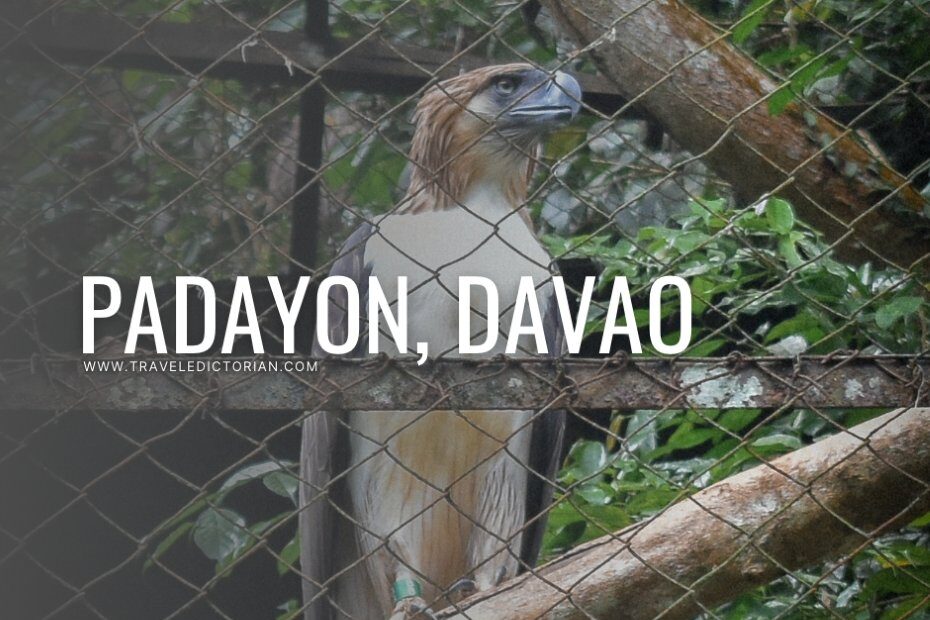
Honestly, this is the very first time I’ve seen up close the Philippines’ national bird, which I often see on the one thousand peso bill. I was utterly in awe while staring at the forest raptors, renowned for its commanding aura.
Davao is not just a haven for the well-known endemic species; however, it is also home to a plethora of intriguing sights that are worth seeing. While plenty of them remained close during my visit, I sought an urban oasis at the People’s Park, where I relished a deeply calming moment in the metropolis.
Disclosure: This post contains affiliate links. When you make purchases through these links, I receive small commissions at no extra cost to you.
Quick Fact About Davao
Davao is deemed the Philippines’ largest city, which encompasses a geographical area of slightly over 2,440 square kilometers. The sprawling metropolis is fourfold larger than Metro Manila.
Visa in the Philippines
Bearers of foreign passports who intend to visit the Philippines should contact the Embassy of the Philippines regarding entry requirements. Otherwise, consult iVisa.com, a reputable and trusted visa service provider.
Having a valid passport and round-trip airline tickets does not guarantee admission into a foreign country. Travelers must go through immigration procedures.
Standard Time in Davao
The Coordinated Universal Time (UTC) in Davao is UTC +08:00.
Davao is four hours ahead of Dubai, seven hours ahead of Paris, and eight hours ahead of London. Moreover, Davao is twelve hours further ahead of New York. In the contrary, Davao City is an hour and three hours behind Tokyo and Sydney, respectively.
Climate in Davao
Davao, much like the rest of the Philippines, exhibits a tropical rainforest climate. The city constantly endures warm temperatures and a considerable amount of rainfall year-round.
Best Time to Visit Davao
Due to its geographical location, which lies outside the Pacific typhoon belt, Davao City is less vulnerable to typhoons. Thus, it is an ideal all-year holiday destination, specifically throughout the dry season.
June to November
In Davao, the rainy season lasts from June to November. Fleeting showers to torrential rain with a high risk of humidity are prevalent during this period, specifically the months of July up until October, which are the wettest months.
Throughout the wet season, costs of flights and hotel rates plummet during the off-peak months, with the single exception of August in celebration of the “Kadayawan Festival.”
December to May
The dry season in the city of Davao spans from December and lasts up until May, with March and April being the driest. Clear skies and a slim chance of rainfall are anticipated, especially throughout the midsummer, along with a high degree humidity.
On the contrary, January and February have mildly cold weather.
Language in Davao
Cebuano, also referred to as Bisaya, a blend of Cebuano and Tagalog, is predominantly the spoken language in Davao. Additionally, Tagalog, along with English, is commonly used for conversation and readily apparent in most public signs and markings.
Here are the essential Cebuano words and phrases to learn before your trip to Davao:
Maayong adlaw kanimo. – Have a good day.
Kinsay inyong ngalan? – What is your name?
Asa kamo gikan? – Where are you from?
Nalipay kong makaila nimo. – Nice to meet you.
Tabang! – Help!
Maka-istorya ba ka Ingles? – Do you speak English?
Please – Palihug
Asa ang banyo? – Where is the comfort room?
Pastilan! – Oh my goodness!
Daghang salamat. – Thank you very much.
Adto na ako. – I am going ahead.
Amping. – Take care.
Currency in Davao
Abbreviated as PHP, the Philippine peso, is the official currency in the Philippines. The exchange rate as of March 27, 2026, is PHP 1.00 or USD 0.016.
Davao Travel Guide Tip: Convert your money to Philippine peso in downtown Davao, as exchange rates are better than at the airport.
Modes of Payment in Davao
In spite of being a highly urbanized city, the metropolis, much like Baguio and the rest of the country, remains a cash-based society where hard money is predominantly utilized for various transactions. Upmarket shops and restaurants and high-end hotels are the only exceptions, as they also accept other forms of payment, such as plastic cards.
Cash
Hard currency is the most commonly used method of payment in Davao City. Almost all in-person transactions are on a cash basis, particularly for modest purchases and fares for public transport.
In the event that you run out of cash, Davao has adequate automated teller machines, or ATMs, spread out across the city center.
Bank Card
Certain establishments, like upscale dining venues, shops, and exclusive hotels, accept swipe cards, specifically those bearing the names “Mastercard” or “Visa.”
Digital Wallet
In addition to cash and plastic cards, virtual wallets, including “GCash” and “Maya,” are gaining widespread acceptance, as they act as a useful backup in case you run short of ready money. A substantial number of retail establishments and lodging facilities honor this mode of payment.
Ways of Getting to Davao
Davao is an independent city, which lies in the eastern portion of Mindanao Island. The city shares a border with Davao del Norte to the northeast, Davao del Sur to the south, and Cotabato to the west. Moreover, Davao Gulf lies east of Davao City.
The Francisco Bangoy International Airport, or Davao International Airport, in Davao City is the primary gateway to the Davao Region and the rest of Southeastern Mindanao. It is the nearest aviation hub to major cities, such as Tagum, Digos, and Samal, handling both domestic and international passengers from Manila, Siargao, and even Hong Kong.
Tagum to Davao City
Located north of Davao City, Tagum is a key city in Eastern Mindanao and the capital of Davao del Norte. Those coming from Tagum may embark on the provincial buses that run parallel in slightly over an hour.
Digos to Davao City
Although Davao City is geographically part of Davao del Sur, it functions autonomously, which distances itself from the rest of the province. As such, those coming from Digos, the provincial capital, may take the intercity buses to Davao City in about an hour.
Samal to Davao City
The Island of Samal is the closest city to Davao, which shares a maritime boundery – the Davao Gulf. Traveling between the two cities might take less than half an hour via a ferry.
Davao Travel Guide Fact: The Davao-Samal Bridge is still a work-in-progress infrastructure initiative that will soon connect the neighboring cities. Once completed in 2028, the sea-crossing bridge will only take 5 minutes to reach Samal from Davao City.
Cotabato to Davao City
The Cotabato Airport, which handles flights from Manila, Cebu, and parts of Mindanao, is the primary entry point to Cotabato and the rest of Maguindanao provinces. Cotabato, which lies west of Davao City, is about a five-hour overland travel, following the Cotabato-Davao City route.
Getting Around Davao
In the absence of a rail service, Davao City, however, offers transit options to serve the vast stretches of the metropolis. In addition to its jeeps, taxis, trikes, and pedicabs, the metro launches a fleet of modern buses that runs at numerous strategic locations.
Bus
In response to the city’s worsening gridlock traffic, modern buses were introduced and initially in operation to service key locations. The Davao City Interim Bus Service, or just DC Bus, is a low-entry public transit service equipped with air conditioning and security cameras.
This fleet of modern buses follows specific routes, which run between downtown Davao and the outlying reaches of the city. The DC bus departs at 6:00 a.m. up until 9:00 p.m. Moreover, the fare for a single journey starts at PHP 15.00 or USD 0.24, while the PHP 12.00 or USD 0.20 discounted fare is due for the elderly, minors, and disabled persons.
Jeepney
A jeepney, frequently referred to as “Uso Uso,” is a highly dependable public transit in Davao City due to its comprehensive routes. This on-ground transport is easily identifiable by its flashy exteriors and frequently plays loud music onboard.
Even though these conventional public jeeps are about to phase out, it is, nonetheless, a highly regarded method of transportation for its unmatched speed. The base fare is PHP 14.00 or USD 0.23 for the first 4 kilometers and an extra PHP 2.00 or USD 0.033 for the succeeding kilometers.
On the other hand, the fare for the electric jeepneys is a little higher; it costs PHP 17.00 or USD 0.28 for the initial four kilometers with an additional PHP 2.40 or USD 0.039 for the following kilometers. Much like the fares for buses, seniors, children, and individuals with impairments are eligible for a reduced fare.
Taxi
Much like the taxis in Bangkok, cabs in the city are readily apparent with their vibrant shades, such as pink, yellow, orange, and the standard color, white. Taking the cab is substantially more convenient, but their fare is slightly pricier than other modes of public transit. Hailing one is fairly simple, as they often park close to ports, shopping malls, and waysides.
As an alternative, use a ride-hailing app, like “Grabcar” or “Green GSM,” which is gaining wide acceptance. The regular taxi in Davao City, which operates around-the-clock, has an initial charge of PHP 40.00 or USD 0.65 and incurs PHP 13.50 or USD 0.22 for every succeeding kilometer.
Tricycle
A tricycle is a three-wheeled, mechanized vehicle, which typically plies back roads and the peripheral areas. This highly dependable utility vehicle is allowed to hold up to three passengers. The base fare for a one-way trip is PHP 10.00 or USD 0.016.
E-Trike
An electric tricycle, or simply an e-trike, is a three-wheeled and motorized-driven vehicle utilized to mobilize passengers, specifically for short distances. This zero-emission public transport, which relies mainly on an electric motor and battery, has a built-in carriage with a canopy that can fit up to two passengers.
The electric tricycle that navigates primarily through secondary roads and streets has a minimum fare is PHP 10.00 or USD 0.16 for a one-way trip.
Pedicab
A “pedicab,” often known as “trisikad,” is a pedal-powered public vehicle mounted with a sidecar that can accommodate up to two passengers. The highly reliable vehicle with a tightly installed umbrella is typically used for short-distances that maneuvers along alleys and streets.
While fare varies based upon the distance, the minimum fare is PHP 10.00 or USD 0.16.
Areas to Stay in Davao
Regardless of whether you are into historical and cultural immersion, nature excursions, or just for retail indulgence, Davao City has an extensive list of sights to see as well as recreational endeavors that tend to draw in tourists. It is interesting to note that all sorts of accommodations reside close to notable attractions and retail venues.
As such, these are the best neighborhoods in Davao City to spend your upcoming holiday break.
Buhangin
Located east of Davao City, Buhangin is the main gateway to the metropolis and the rest of the Davao region, being home to the Francisco Bangoy International Airport. It is also the main access point to the island of Samal, as ferries typically depart from Sasa Wharf.
Besides a primary transit hub, Buhangin is a heavily residential district and a sprawling commercial center with retail venues dotted across the neighborhood. In addition, lodging options, like the Dusit Thani Residence and the Davao Airport View Hotel, reside in this transit-accessible area.
Agdao
Southward of Buhangin, the Agdao District-specifically, Lanang-is a thriving business hub with diverse corporate offices and retail establishments. In addition, the commercial district has extensive short-term rentals and hotel options, including the less expensive Hop Inn Hotel Davao and the full-service hotel, Acacia Hotel Davao.
Poblacion
Poblacion, most commonly referred to as downtown Davao City, is the administration center and cultural hub. The urban core is home to several notable places of interest, like the National Museum of the Philippines – Davao, which is adjacent to a medley of accommodation options, like the Rogen Inn and Apo View Hotel Davao.
Internet in Davao
Davao extends free wireless internet access in selected public spaces, such as transport terminals and the People’s Park. Moreover, complimentary Wi-Fi is frequently offered by hotels and even in many coffee shops.
As an alternative, consider getting a prepaid 5G eSIM for added convenience while taking a tour around Davao City.
Power Adaptor in Davao
Davao operates on a 220 V supply voltage with a frequency of 60 Hz and uses a type of power adaptor:
A or has two flat parallel pins
Davao Travel Guide Itinerary
Highlights: Philippine Eagle Center, National Museum - Davao, People's Park, and Roxas Night Market
Davao Travel Guide Reminder: Minors who are traveling alone or those accompanied by non-parents to Davao City must obtain a travel permit from City Social Welfare and Development Office or Special Office for Children’s Concern.
Day 1 - Baguio and Poblacion
Davao Travel Guide Reminder: It takes around 450 meters to walk from points A to B.
10:40 am – 11:10 am Confirm reservation and early check-in at Asrodel Hotel, and drop the luggage
Davao Travel Guide Tip: As an alternative, stay in a hostel. A hostel is an inexpensive lodging facility that offers basic amenities, such as bunk beds and shared bathrooms. Thus, book a hostel in Davao if you are on a tight budget.
11:10 am – 12:00 pm Early lunch
12:00 pm – 12:03 pm Walk to Roxas Avenue
From the hotel
Walk toward Roxas Avenue via Padre Faura Street
12:03 pm – 01:00 pm – Head to Calinan Proper
From Roxas Avenue
Take a jeepney toward Calinan Proper
Alight at Phoenix 3 Petroleum Station, R. Magsaysay Street
01:00 pm – 01:15 pm Head to the Philippine Eagle Center
From Phoenix 3 Petroleum Station
Take a tricycle to Philippine Eagle Center
Alight and walk toward Philippine Eagle Center
01:15 pm – 03:30 pm Explore Philippine Eagle Center and have lunch
Philippine Eagle Center
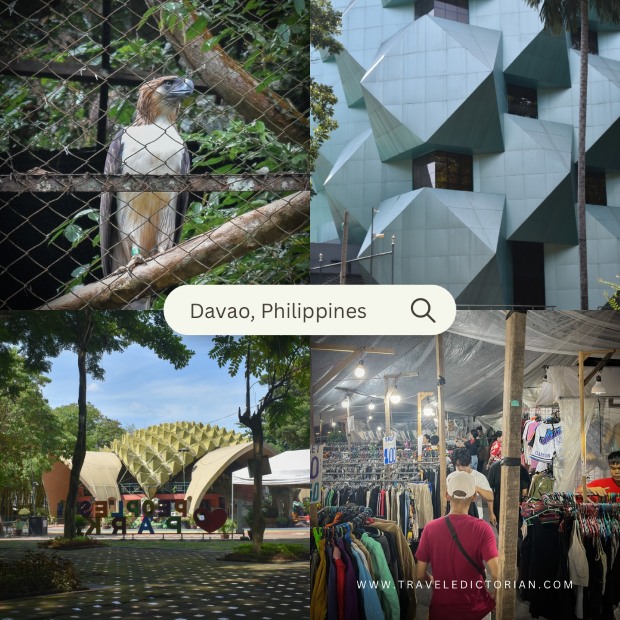
The Philippine Eagle Center, established in 1987, is a rescue facility and a conservation institution that is strongly committed to the rehabilitation and the protection of wildlife, primarily the gravely endangered Philippine eagle species.
This densely forested sanctuary, located at the foot of the Philippines’ tallest peak, Mt. Apo, also functions as an artificial breeding site for the highly threatened giant bird of prey before its release back to the wild. The Philippine Eagle Center typically opens daily from 8:30 a.m. until 4:30 p.m.
A single-entry ticket costs PHP 300.00 or USD 4.88 for visiting adults. A discounted admission fee, on the other hand, is due to seniors, students, and PWDs.
03:30 pm – 03:45 pm Head toward Calinan Transport Terminal
From Philippine Eagle Center
Walk to Calinan-Baguio-Cadalian Road
Take a tricycle to Calinan Transport Terminal
Alight Calinan Transport Terminal
03:45 pm – 04:45 pm Head to hotel
From Calinan Transport Terminal
Take a jeepney toward Roxas Avenue
Alight at Roxas Avenue
Walk toward hotel via Padre Faura Street
04:45 pm – 06:00 Hotel check-in and take a nap
06:00 pm – 06:03 pm Walk to Roxas Night Market
From the hotel
Walk toward Roxas Avenue via Padre Faura Street
06:03 pm – 09:00 pm Dine and shop at Roxas Night Market
Roxas Night Market
The Roxas Night Market, which spans along Davao’s main thoroughfare, is a temporary marketplace set up that consists of tent-like stalls, or “tiangges,” that are pedestrianized and publicly accessible during nighttime. Independent vendors offer a broad range of products and services, such as local flavors, souvenir items, pre-owned goods, and even outdoor massages, at reasonable prices.
Roxas Night Market typically opens between 5:00 p.m. until midnight.
09:00 pm – 09:03 pm Head back to hotel
09:03 pm – 10:30 pm Prepare for sleep
10:30 pm Sleep
Day 2 - Poblacion
Davao Travel Guide Reminder: It takes around 800 meters to walk from points A to B.
07:00 am – 09:00 am Wake up, prepare for the tour, have breakfast, early check-out, and drop the luggage
09:00 am – 09:10 am Head to People’s Park
From the hotel
Walk to People’s Park via Artiaga Street
Turn left at A. Mabini Street
Then turn left at Padre Gomez Street
Turn right at J. Palma Gil Street
09:10 am – 12:00 pm Explore People’s Park and National Museum of the Philippines – Davao
People's Park
The People’s Park, located in Poblacion, is a 4-hectare urban park. This green space, a home to a diverse species of plants, features a garden, man-made waterfall, a children’s playground, sorts of public art installations, and a museum.
The recreational park, which is an excellent location for fitness activities or simply for relaxation, is open daily, typically as early as 5:00 a.m. to 11:00 a.m. and 1:00 p.m. until 10:00 p.m. Admission to the People’s Park is free.
National Museum - Davao
Situated at the People’s Park grounds, the National Museum of the Philippines – Davao is a historical and a cultural institution. The durian-resembling museum houses a vast collection of indigenous articles and works of art, mainly from the region.
The National Museum of the Philippines – Davao is open from Tuesday to Sunday from 9:00 a.m. up until 5:00 p.m. whereas the last admission is 30 minutes before closing time. Entrance is free.
12:00 pm – 01:00 pm Have lunch
01:00 pm – 01:10 pm Head to hotel
From the People’s Park
Walk to the hotel via J. Palma Gil Street
Turn left at Padre Gomez Street
Then turn right at A. Mabini Street
Turn right at Artiaga Street
01:10 pm – 01:30 pm Get the luggage and check-out
One moment, please! Why not explore the “Crown Jewel of Mindanao” while taking a leisurely drive? Join in an organized tour. Book Davao City Highlights Full Day Tour!
01:30 pm – 2:10 pm Head to Francisco Bangoy International Airport
From the hotel
Take a taxi to Francisco Bangoy Airport
Alight at Francisco Bangoy International Airport
02:10 pm – 05:25 pm Check-in and boarding
Davao Travel Guide Reminder: Prior to boarding, passengers who are carrying agricultural commodities and marine products must obtain a “Clearance for Domestic Transport” at the Quarantine Office of the Department of Agriculture, Davao Airport. The clearance is free of charge.
In 2025, I spent PHP 3,438.89 on a two-day trip in Davao. Travel expenses, however, may still vary with your spending habits. Please read the “35 Excellent Tips to Save Money on Travel.”
Here are the itemized travel expenses in Davao for your reference:
Pre-Departure
Francisco Bangoy International Airport to Ninoy Aquino International Airport via plane, PHP 1,023.20
2D1N accommodation, PHP 1,695.38/2, PHP 847.69
1st Day
Sasa Port to hotel via taxi, PHP 240.00/ 2, PHP 120.00
Roxas Avenue to Calinan Proper via jeep, PHP 55.00
Calinan Proper to Philippine Eagle Center via tricycle, PHP 30.00
Lunch, PHP 105.00
Environmental Fee, Philippine Eagle Center, PHP 5.00
Admission Fee, Philippine Eagle Center, PHP 300.00
Tip to Guide, PHP 200.00
Philippine Eagle Center to Calinan Transport Terminal via tricycle, P 20.00
Calinan Transport Terminal to Roxas Avenue, PHP 53.00
Dinner, PHP 150.00
2nd Day
Breakfast, PHP 110.00
Lunch, PHP 145.00
Hotel to Francisco Bangoy International Airport via taxi, PHP 250.00/2, PHP 125.00
Travel Resources
To help you with your travel preparations, I have compiled a list of booking tools that I highly recommend for their excellent deals.
Looking for an easy-peasy solution to process your visa application and other travel documents? Consult iVisa!
SafetyWing is your safeguard for travel medical and health insurance while away from home.
The sky is the limit with Skyscanner if you are looking for better and cheaper flight options for your next trip.
Reserve a room on one of the largest online hotel booking platforms, Agoda. It offers unbeatable hotel deals!
Explore the world with HostelWorld! Make a reservation and share a space with newfound buddies.
Drive your way to undiscovered places! Book a car via Discover Cars and experience hassle-free road trips.
Would you like to visit your favorite museum and theme park? For discounted attraction tickets and tours, look for Klook!
For transfers from point A to point B, go for 12Go! It has an extensive coverage of ground transports and ferries, too.
Davao Travel Guide Question: What is the largest city in the Philippines in terms of land area? Please leave your answer and remarks in the comment section.
About the Author
J. Sac is the author of “Davao Travel Guide: An Excellent Guide to the World.” He is also the founder of Traveledictorian – a travel blog that publishes well-thought-out travel content.
His passion for writing, photography, and travel fueled him to explore Asia and the rest of the world. He also plans to undertake humanitarian work in his travels. Read his inspiring story and follow him on social media!
P.S. Subscribe to our newsletter for the newest travel guides and the latest updates in the travel industry.